
Environmentally Friendly Patient Warming
Go Green with HotDog
HotDog is a reusable, air-free patient warming system designed to reduce OR waste, lower energy use, and support hospital sustainability goals. Recent peer-reviewed evidence in cardiac surgery found that reusable HotDog direct-conduction warming pads reduced solid waste by 99.5%, reduced per-case warming pad cost by 58%, and used approximately 10x less electricity than single-use warm-water warming technology. 1 2
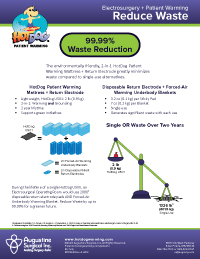
HotDog can also reduce disposable warming waste by up to 99.99% compared with single-use forced-air warming workflows, based on disposable waste avoided over the service life of a comparable reusable HotDog device. 3

Recent Peer-Reviewed Evidence
99.5% Less Solid Waste
A 2,990-case cardiac surgery analysis published in British Journal of Anaesthesia found reusable HotDog U102 warming pads reduced solid waste from 454 g per case to 2 g per case compared with single-use warm-water underbody warming pads. 1
58% Lower Per-Case Cost
The same analysis found per-case warming pad cost decreased from CAN$17.50 to CAN$7.33 with reusable HotDog U102 warming pads. 1
Approximately 10x Lower Electricity Use
A follow-up BJA pilot study found reusable HotDog direct-conduction warming pads used 0.19 kWh per case compared with 1.9 kWh per case for single-use warm-water warming technology. Mean power input was 40 W vs 340 W. 2
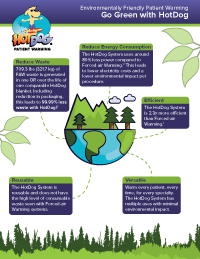
Less Waste
709.3 lbs (321.7 kg) of FAW waste is generated in one OR over the life of one comparable HotDog blanket. Including reduction in packaging, this leads to 99.99% less waste with HotDog! 3
Efficient
The HotDog Patient Warming System is 2.3x more efficient than Forced-Air Warming. 4 It produces much less energy to achieve the same heat transfer per square area. HotDog warms above and below simultaneously.
Lower Energy Consumption
The HotDog Patient Warming System uses around 80% less power compared to Forced-Air Warming. 4 This leads to lower electricity costs and a lower environmental impact per procedure.
Versatile
Warm every patient, every time, for every specialty. HotDog has multiple uses resulting in minimal environmental impact.
Reusable
The HotDog Patient Warming System is reusable without the high level of consumable waste seen with Forced-Air Warming systems.

Life Cycle Pollution Impacts of Reusable Versus Disposable Patient Warming Blankets 5
This Life Cycle Assessment (LCA) study was performed at Yale-New Haven Hospital with the goal of determining the environmental impacts of three different patient warming systems. LCA is an internationally standardized, science-based approach to quantify multiple environmental and public health impacts of a product or process over its entire life span, from raw materials extraction, transport, use and reuse, and end-of-life disposal.
“Using the reusable blanket in lieu of either of the disposable models provides a significant decrease in environmental impacts due to patient warming. 5”
Create a More Sustainable World

The electricity required for forced-air warming systems is ~20% of the total carbon footprint associated with anesthesia during surgery. 6 With environmentally friendly patient warming, HotDog can reduce that by 80%. Furthermore, waste is reduced by 99.99%.

Reusable
Reusable means fewer shipments and lower carbon emissions by shipping vehicles across the globe.

Quiet
Forced-air warming creates noise pollution at levels up to 84 dBA. HotDog creates virtually no noise pollution. 7

Less Pollution
The HotDog Temperature Management System can help reduce emissions by 80% in facilities that are currently using Forced-Air Warming. 4
References
- Abou Jamous J, Rousseau-Saine N, Lebon JS, Williams S. Retrospective analysis of the clinical, financial, and solid waste performance of reusable active intraoperative normothermia warming pads for cardiac surgery. Br J Anaesth. 2025;134(2):610-612. doi:10.1016/j.bja.2024.11.032.
- Williams S, Larose C, Bernier MC, Rousseau-Saine N. Analysis of electrical energy consumption of reusable active intraoperative warming pads compared with single-use warm water warming pads for cardiac surgery. Br J Anaesth. 2025;135(6):1842-1843. doi:10.1016/j.bja.2025.08.020.
- Waste reduction estimate based on one full-body forced-air warming blanket weighing 7 oz (198 g), 2.6 uses per surgery day, 250 surgery days per year, over 30 months, compared with one reusable B104 HotDog Full Body Warming Blanket. Actual waste reduction depends on product mix, case volume, replacement schedule, and facility practices. Data on file.
- Bayazit Y, Sparrow EM. Energy efficiency comparison of forced-air versus resistance heating devices for perioperative hypothermia management. Energy. 2010;35(3):1211-1215.
- Smith-Mannschott K, et al. Life Cycle Pollution Impacts of Reusable Versus Disposable Patient Warming Blankets. Presented at: American Society of Anesthesiologists Annual Meeting; 2014. Abstract A3194.
- McGain F, Sheridan N, Wickramarachchi K, Yates S, Chan B, McAlister S. Carbon footprint of general, regional, and combined anesthesia for total knee replacements. Anesthesiology. 2021;135(6):976-991.
- Katz JD. Noise in the operating room. Anesthesiology. 2014;121(4):894-898. doi:10.1097/ALN.0000000000000319.