

Every patient who enters the operating room begins to lose heat. Even in a 70°F OR, anesthesia suppresses the body’s ability to regulate temperature within minutes. Without active warming, most patients become hypothermic during surgery: defined as a core temperature below 36 °C.
While a one-degree drop may sound minor, research shows that even mild hypothermia can increase surgical complications, recovery time, and total cost of care. Maintaining normothermia is one of the simplest and most effective ways to improve outcomes across surgical specialties.
A new 2025 PLOS ONE study (Desai et al.) highlights the continued importance of active warming, showing that the type of warming system used plays a significant role in maintaining normothermia during surgery.
The Hidden Risk in Every OR
Inadvertent perioperative hypothermia affects up to 70% of surgical patients when active warming is not used (Mahoney & Odom, AANA Journal, 1999). The consequences reach far beyond patient comfort.
- Higher infection risk: A landmark New England Journal of Medicine study (Kurz et al., 1996) found that maintaining normothermia reduced surgical-wound infections by 64%.
- Increased blood loss: Even a 1.5 °C drop in core temperature increased transfusion requirements by 20%–40% (Schmied et al., Lancet, 1996).
- Cardiac complications: Hypothermia nearly tripled the rate of morbid cardiac events such as ischemia (Frank et al., JAMA, 1997).
- Higher costs: Treating hypothermia-related complications adds $2,500–$7,000 per patient (Mahoney & Odom, 1999).
The Cost of Getting Cold in the OR
64%
Higher risk of surgical-wound infection1
20%–40%
Increase in transfusion requirements2
3x
Greater Likelihood of morbid cardiac events3
$2,500–$7,000
Per patient4
How the Body Loses Heat Under Anesthesia
During surgery, heat escapes through radiation, convection, evaporation, and conduction. But the greatest drop occurs in the first 30 minutes after induction, when anesthesia triggers vasodilation and redistributes warm blood from the core to the skin.
That’s why modern protocols — including NICE CG65 and AORN Guidelines — emphasize starting warming before incision and maintaining it throughout the procedure.

Up to 80% of intraoperative heat loss occurs within the first hour.
The Science Behind Modern Patient Warming
Two technologies dominate perioperative warming today:
- Forced-air Warming (FAW): Uses convection: blowing warm air through disposable blankets.
- Conductive fabric (air-free) warming: Uses direct conductive heat through reusable blankets and mattresses, transferring warmth efficiently via contact.
In a randomized controlled trial (Journal of Anesthesia and Surgery, Sugai et al., 2018), air-free conductive warming increased patient temperature 0.35 °C per hour, compared to 0.01 °C with Forced-air Warming — a statistically significant difference (p < 0.05).
Additionally, Surg Technol Int (Ohki et al., 2019) found that when warming both above and below the patient, conductive systems achieved higher intraoperative core temperatures than combined Forced-air + water-mattress setups.

The most recent randomized clinical evidence reinforces these findings.
In 2025, Desai et al., PLOS ONE, compared four warming strategies in 182 surgical patients: conductive warming (CW) with and without prewarming and forced-air warming (FAW) with and without prewarming (DOI 10.1371/journal.pone.0325954). Using AUC <36°C as the measure of hypothermia burden, the authors found that conductive warming preserved markedly more normothermia than forced-air. When normalized to a 0–100 “Normothermia Score,” CW with prewarming maintained 76% of normothermia, compared to 60% for FAW with prewarming, 63% for CW without prewarming, and 0% for FAW alone.
Conductive Warming Significantly Increased Intraoperative Normothermia Compared to Forced-Air
Chart shows normalized inverse metric of raw median hypothermia (AUC <36°C) values. CW/CW 4.7. NAPW/CW 7.4. FAW/FAW 8.0. NAPW/FAW 19.9.
Normothermia Score = AUC (˚C*min) relative to the historical standard of care. The historical current standard of care is intraoperative FAW with a median AUC of 19.9. A Normothermia Score of 1 would mean that core temperature never dips below 36˚C.
Why Hospitals Are Moving Away from Forced-Air Warming
While Forced-air systems have been the traditional standard, growing evidence shows that their waste heat can disrupt laminar airflow and increase airborne particles in the sterile field.
- Dasari et al., Anaesthesia 2012: Forced-air Warming increased surgical-site air temperature by 2.7 °C, disrupting laminar flow.
- Legg et al., Bone & Joint J 2013: Found 2,000× more airborne contaminants over the surgical site when FAW was used compared to conductive warming.
- McGovern et al., J Bone & Joint Surg Br 2011: When Forced-air was discontinued, deep-joint infections dropped by 74% across >1,400 cases.
The American Association of periOperative Registered Nurses (AORN) and multiple hospital quality-improvement projects have since encouraged evaluating air-free alternatives, particularly in implant or ultraclean environments.
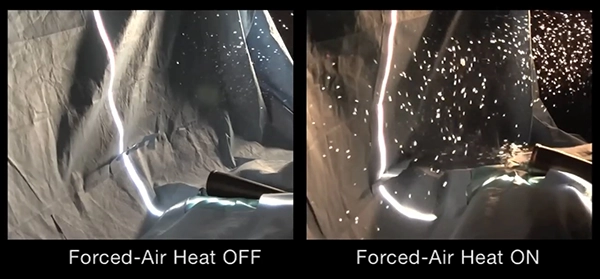
Forced-air causing a vortex carrying contaminants to the sterile field.
Building a Safer, Greener Operating Room
Air-free conductive systems also advance hospital sustainability initiatives. Over the lifetime of a single reusable underbody warming mattress, an OR can eliminate over 900 lbs (408 kg) of disposable waste — a 99.8% reduction compared to single-use Forced-air blankets and grounding pads.
A life-cycle assessment presented at the American Society of Anesthesiologists (Smith-Mannschott et al., 2014) confirmed that reusable conductive systems have lower environmental impact across all measured categories — including greenhouse gas emissions and landfill burden.
Waste Comparison Over 2 Years
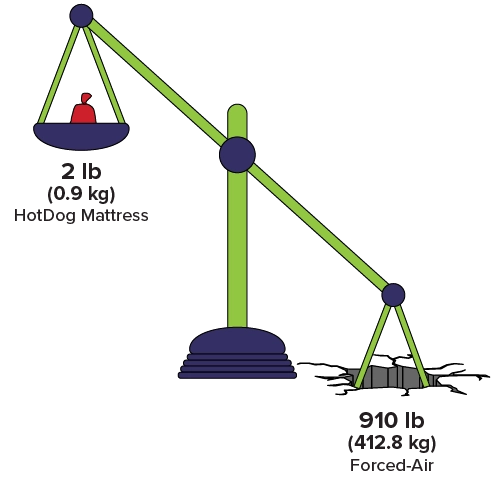
Weight of 2080 Forced-air Warming Underbody Blankets (7 oz ea.)
Key Takeaway: Patient Warming as a Standard of Care
Patient warming isn’t just about comfort — it’s a matter of safety, efficiency, and responsibility.
By maintaining normothermia, surgical teams can:
- Reduce complications and length of stay
- Protect staff and patients from airborne contamination
- Support hospital sustainability goals
“Do no harm is at the core of medicine. Warming safely — without blowing air — is part of that mission.”
— Dr. Scott Augustine, Inventor of HotDog Patient Warming
Further Reading
- Kurz A, et al. NEJM. 1996; 334:1209-1215.
- Schmied H, et al. Lancet. 1996; 347:289-292.
- Frank S, et al. JAMA. 1997; 277:1127-1134.
- Mahoney C, Odom J. AANA J. 1999; 67(2):155-164.
- Sugai H, et al. J Anesthesia & Surgery. 2018.
- Ohki K, et al. Surg Technol Int. 2019; 34:40-45.
- McGovern PD, et al. J Bone & Joint Surg Br. 2011; 93B:1537-1544.
- Dasari KB, et al. Anaesthesia. 2012; 67:244-249.
- Smith-Mannschott K, et al. ASA Annual Meeting 2014 A3194.
- Augustine S. M206E Research Summary, Augustine Temperature Management, 2021.